Showing posts with label NASA. Show all posts

12.24.2013

An Offering for Christmas Eve


This time of year is significant for many people. Some recognize the birth of Christ, others the miracle of the lamp oil, still others the solstice and the return of light.
Light is a common theme - the light of the guiding star, light of hope, light of God, light of the sun. So too, the restful darkness that lets us appreciate the light and renew it within ourselves.    
It is also a time to appreciate the light of knowledge. A time to celebrate our ability to light the dark and keep warm in the cold. A time to marvel at our ancestors observing the skies and knowing the changing seasons.
The finest reminder of the light for me is the Christmas Eve broadcast from Apollo 8 in 1968. The crew and their craft represented a coalescing of light - the light of knowledge and ingenuity, the light of bravery and exploration, the light of faith - in God or scientists and engineers.
The account of creation in Genesis, of the creation from darkness was apt-regardless of personal belief - as a major part of the Western canon it influences art even today. And the theme of naming having power and causing things to come into being is a common one in mythology and can be seen in a way in the voyage of Apollo 8 itself.     President Kennedy called for the US to send a man to the surface of the moon and bring him back by the end of the decade. He spoke, millions listened, thousands worked and created and transformed words into actions and things.
So, on Christmas Eve, I wish you all well in the restful dark and the returning light and offer you the reading given by Frank Borman and Jim Lovell and Bill Anders from the depths of space between Earth and Moon on December 24, 1968. 


8.25.2012

Godspeed, Neil

Neil Armstrong photographed by Buzz Aldrin aft...
Neil Armstrong photographed by Buzz Aldrin after the completion of the Lunar EVA on the Apollo 11 flight (brighter and smaller version) (Photo credit: Wikipedia)
Neil Armstrong by most accounts was a quietly competent, unassuming guy, as the following snippet should illustrate:

He accepted a teaching position in the Department of Aerospace Engineering at the University of Cincinnati, having decided on Cincinnati over other universities, including his alma mater, Purdue, because it had a small Aerospace department; he hoped that the faculty members would not be annoyed that he came straight into a professorship with only the USC master's degree. (Source)


Awesome pilot. Best of luck to him on the next great adventure.

I hope we continue in his footsteps in exploration and innovation.


7.23.2012

Rest in Peace, Dr. Ride

Sally Ride, the first American woman in space.
Sally Ride, the first American woman in space. (Photo credit: Wikipedia)
Reading the NYT article is a wonderful refresher of how far gender equality has come and how much further we still have to go.
Example:
...politely endured reporters’ asking...whether she would wear a bra or makeup in space, whether she cried on the job...
I'm pretty sure that I would have had some really entertaining names to call people asking idiotic questions like that. Or remarkably snarky responses.
"Nope, no bra. Should make it easier for the topless astronauts gone wild video we'll be making in cooperation with Playboy to afford the next shuttle launch."
"My brain saps too much energy for me to menstruate. Should I start bleeding, though, I'll be isolated in the payload bay for 3-5 days so as not to destroy the guidance system with my scary lady mojo."
"I haven't cried on the job yet, but this press conference is getting me close to tears of rage. Lemme go put on some mascara and you can get a Tammy Faye shot."

On the flip side, women still have to deal with stupid-ass questions just like that.
Dr. Sally Ride was a driven, talented person and an inspiration to a generation of children interested in space flight, male and female.


10.07.2010

Space photos of the day: Vintage NASA art - The Christian Science Monitor - CSMonitor.com

Space photos of the day: Vintage NASA art - The Christian Science Monitor - CSMonitor.com

The slide show is awesome. I have to confess to having a little internal giggle every time I see the Dyna-Soar project mentioned.

I really want an inflatable space station.

And whoever drew the Apollo space suit (final slide) was clearly just phoning it in that day. "So, we'll get some toilet paper and duct tape..."

4.12.2010

Attention Fellow NASA Geeks: 40th Anniversary of Apollo 13

The Adler Planetarium, Chicago, IL is hosting some special events in Chicago and online, including Jim Lovell "taking over" the Adler's Facebook fan page and Twitter feed, a panel discussion this evening (tickets available at the link above).

Apollo 13 launched in April 1970, intended to be the second manned landing and exploration of the moon.  Sadly, the public had already lost interest in NASA and the Apollo program, despite the first landing having been only a few months prior in June 1969.
The crew consisted of Commander Jim Lovell - his fourth flight; Command Module Pilot John Swigert, and Lunar Module Pilot Fred Haise, Jr.  Swigert was a last minute replacement after the original CM pilot, Mattingly was exposed to rubella and there was concern he might come down with it during flight.  It was the first space flight for both pilots.
The mission went smoothly until 2 days in when the crew was asked to stir the hydrogen and oxygen tanks.  In space, the contents got "slushy" and separated making estimating quantities a bit tricky, among other problems, so standard procedure was to stir it every so often to mix it up a bit.  Unfortunately, an electrical short ignited the tank insulation, the fire raised pressure in the tank dramatically, and, well, boom.
As a result, the moon landing was cancelled, the crew was left with only minimal power for the main (command) module due to loss of the hydrogen and oxygen needed for power production, and it wasn't even clear if they could successfully return to earth.
The crew in Mission Control worked feverishly trying to puzzle out a new mission plan, figure out how to get the crew home, and figure out how to implement changes in the plan successfully.  One of the first decisions was to shut down everything in the command module to conserve power there for systems that would be vital for re-entry and move the crew into the Lunar Module as a "life-boat" - a very cramped, moist, damp life-boat meant only for 2 people for a limited time that now had to accommodate 3 for an extended period.
There was debate over how best to bring them back - attempt a course change to bring them back directly or continue to the moon on the "free return trajectory" that would require minimal course changes.  The free return took a bit longer, but was in many ways safer - they had no way of knowing how much fuel was left for the maneuvering jets or even if they could successfully fire them with sufficient precision to manage a direct return.

Once that was settled, things calmed a bit until the realization that the carbon dioxide scrubbers in the LM weren't up to the task of maintaining a breathable environment for 3 people for a sufficient amount of time.  In a show of awesome ingenuity, the engineers back on Earth took a look at everything they knew the crew had available on the spacecraft and cobbled together a solution using the scrubbers meant for the command module and managed to explain how to build the crazy thing via audio.  Imagine trying to explain how to build an unfamiliar device to someone when you can't see them and they can't see you - awesome!  That and no fancy calculators or computers and no internet.  Just caffeine, nicotine, and slide-rules, baby.

Deke Slayton shows the carbon dioxide scrubber fix to NASA admins.  For those wondering, yes, duct tape was involved.  Duct tape and enormous nerdy brains.
It worked.
The "mailbox" in place in the LM.  Why, yes, it does appear to be made of WIN and AWESOME.

The remainder of the flight was long, cold, and dark - everything non-essential was powered down, including heat, which caused condensation to build up.  Poor Haise wound up with the urinary tract infection from hell and got to deal with the poor conditions while spiking a fever.  No one could sleep very well being so cramped and uncomfortable and, oh, I don't know, being a wee bit stressed out.
They did though - after some tense moments when radio silence during re-entry lasted a bit longer than estimated, the crew made it through to splashdown.  It's probably one of the finest testaments to human ingenuity in history.
Yeah, cigars are definitely in order here.  Really, I think they could have brought in hookers and blow and no one could have said shit.  

All images courtesy of NASA.

3.13.2010

Breaking News: New Evidence the Moon Is Made of Cheese

Why else would astronauts have to leave mousetraps near the LM pads? TEACH THE CONTROVERSY!!!!
Posted by Picasa

2.23.2010

Awesome Project Mercury Photo

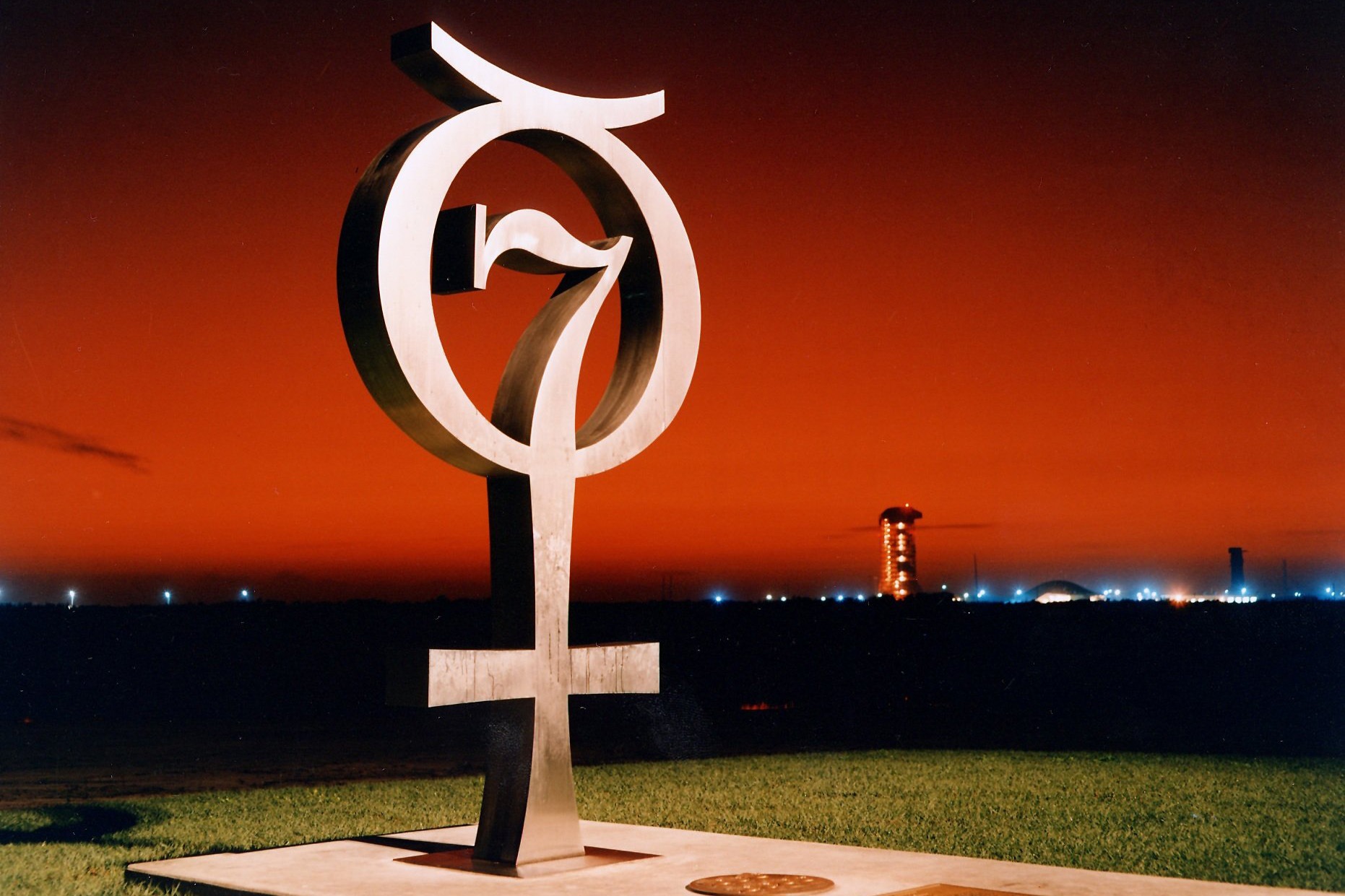
Courtesy of Wikimedia Commons/NASA
I found this on the Wiki page about Project Mercury when I was making sure I hadn't mixed up the Redstone and Atlas rockets.  Every time I see this image I think it's either heavily Photoshopped, a painting, or a sci-fi book cover.  It's a pretty awesome monument.  I'm glad they didn't leave Deke out, even though he didn't fly a Mercury mission.

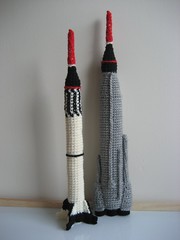
Crochet Mercury Redstone and Atlas

Ms Premise-Conclusion has done it again! I featured her earlier crocheted rocketry a while back.  Now there is more early NASA awesomeness - this time the Redstone and Atlas rockets used for the Mercury launches - the first manned launches in the US. The Redstones managed to heave the Mercury capsules into sub-orbital flights (Shepard and Grissom) and the Atlas managed orbital flights for all the remaining men of the 7 chosen as astronauts except for Slayton who was grounded for health reasons.
The also sent up chimps. Supposedly because they could be trained to perform some tasks in the capsule and thus give an idea about action and function during spaceflight, but I rather like the theory that it was just because someone at NASA hated chimps.

2.01.2010

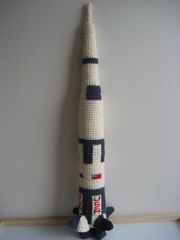
Crochet Saturn V


Crochet Saturn V
Originally uploaded by Ms Premise-Conclusion
I am having serious nerd-gasm here. I've talked before about my love of the early US space program. In my idea notebook there is a page devoted to ideas for amigurumi and other crocheted items and space stuff is on it. I don't know if I would be quite ambitious enough to do the Saturn V or patient enough to try to keep in in scale, but Ms. Premise-Conclusion did both!!!
I am in awe. Sooooo nifty cool.
Even better - there's a pattern for sale in her Etsy shop! Get your nerdy butts over there, people!

10.28.2009

Knitting in Space?

So, I was yammering excitedly to Tom about the Ares launch today, which led to me saying that I wish I could be in a launch as opposed to just watching one, but that's not likely considering that I'm broken. So Tom said that maybe they'll find something to inject in my brain to make me better. And I said maybe they'll figure out that I'd feel better in zero gravity. I actually do wonder about that... Anyway, then I, of course, wondered if you can knit in zero gravity. I see no reason why you shouldn't, though I suspect being overly vigorous in the motions could send you careening about and I would imagine it would take a little while to get used to dealing with inertia but not gravity in keeping stitch tension.
And then I thought I'd go look around to see if anyone ever has knit in space. A few quick Google searches didn't turn up anything, unfortunately. However, if anyone knows if it has been done, do please let me know - especially if there's video.

What I did turn up is below, however. A link to a NASA page about using textiles for composite wing-structures and using principles drawn from knitting, sewing, quilting, weaving, etc., to develop and make the materials. Pretty nifty.
Advanced Stitching Machine: Making Composite Wing Structures Of The Future

As a bonus little (?) known fact: Like a lot of kids, I wanted to be an astronaut. I was pretty hard core about it, though. I went to Space Academy (and I totally want to go again). I loved the books and documentaries that came out around the time of the 25th anniversary of the first moon landing. I worked extra hard at science in math through junior high and high school (my two worst subjects) and started making connections with people (politicians) in the hope of getting a recommendation for the Air Force Academy. My plan was to go through the Academy, become a test pilot, and then head to NASA. I was waaay more interesting in flying the shuttle than being a payload or mission specialist. Unfortunately, my sophomore year I discovered I had mitral valve prolapse, a condition that I was fairly certain would mean there was little chance I'd be allowed to fly. The pediatric cardiologist agreed with me on that score - I recall him being genuinely sympathetic and kind when he told me, too. So, I fell back on my first choice of what I wanted to be when I grew up - Egyptology - and re-directed my energy toward that goal.
I still love space stuff, though. Perhaps predictably, I tend to be far more interested in the human stories and histories than the technical details, though. In the past 18 months or so, I've discovered some of the wealth of historical material NASA and others have made available on the web and am thrilled by it. I'm also really pleased that they've taken the time and effort to do oral history recordings and transcriptions. There is a huge mine of potential data and primary sources there for historical research.

Look at her go!


Beautiful launch today of the Ares I-X rocket.  She's supposed to be the launch vehicle for the new Orion capsule.  The two together are planned to be replacements for the Space Shuttle.

Seeing a launch in person is on my list of things I want to do someday.

7.20.2009

Happy 40th Anniversary of Apollo 11

Forty years ago today, Neil Armstrong and Buzz Aldrin were the first humans to set foot on the moon while Michael Collins waited for them in lunar orbit and the rest of humankind waited for word back on Earth. Watching the footage still takes my breath away.


If any of you out there are as geeky as I am about the early US space program, there are a number of wonderful resources available on the web. One of my favorites is the Apollo Lunar Surface Journal. It's a collection of photographs, transcripts, video, and audio of each of the landing missions. It's remarkable to me to listen to the audio of the astronauts talking between themselves and back to the CAPCOM on Earth and realize what a tenuous link they had back home while in such a beautiful, hostile environment.

I also highly recommend seeing In the Shadow of the Moon it's a very stark, wonderful documentary that focuses on interviews with the astronauts themselves as well as archival footage without the distraction of fancy voice-over narration or elaborate graphics or music. Very powerful and very moving.