Showing posts with label series. Show all posts

7.18.2009

Egyptian Art/Egyptology Series Part 2

I was messing around on Digital Egypt for Universities (one of my very favorite on-line Egyptology resources) and found these reliefs from the mastaba of Tepemankh at Saqqara. A mastaba is a type of tomb, particularly popular during the Old Kingdom among high officials. The burial itself was typically at the bottom of a deep shaft. The mastaba was built up over the shaft usually with mudbrick, rubble, and a nicer facing of limestone, with a flat top and slightly sloped sides. Niches and internal chambers were often included to allow the deceased to receive offerings from priests and/or from their descendants and this is where the majority of the decoration appears. The word is actually Arabic and is the term for a sort of bench often appearing on the exterior of houses and shops.

Anyway, I particularly like these not only for their wonderful Old Kingdom quality, but also for the translations available. If you click on UC14309 you can see translations of the writing around the craftsmen. I am a particular fan of the overseer saying to one of the craftsmen: "Sloth is unbearable to Sokar, O Craftsman." In a less literal translation - "Get off your lazy ass and work faster, you!" I love that such a slightly humorous and very normal human interchange was recorded in Tepemankh's tomb. The interchanges about bartering for sandals and carrying goods seen on UC14310 are also pretty fun.

This is one of the best parts of visiting museum collections (or the in situ monuments) or examining exhibition catalogues numerous times - you begin to notice more the smaller details included in scenes that are absolutely charming, whether it's a conversation between workers, a fight between dancing girls, a little boy about to pull the tail of a pet monkey, or the inclusion of a farmer's bald spot.

6.30.2009

Favorite Egyptian Pieces

I've decided to start up a new series here featuring ancient Egyptian "art" pieces on a semi-regular basis. At some point I will also put together a post explaining why I have art in quotation marks up there - today my brain is simply not up to it.

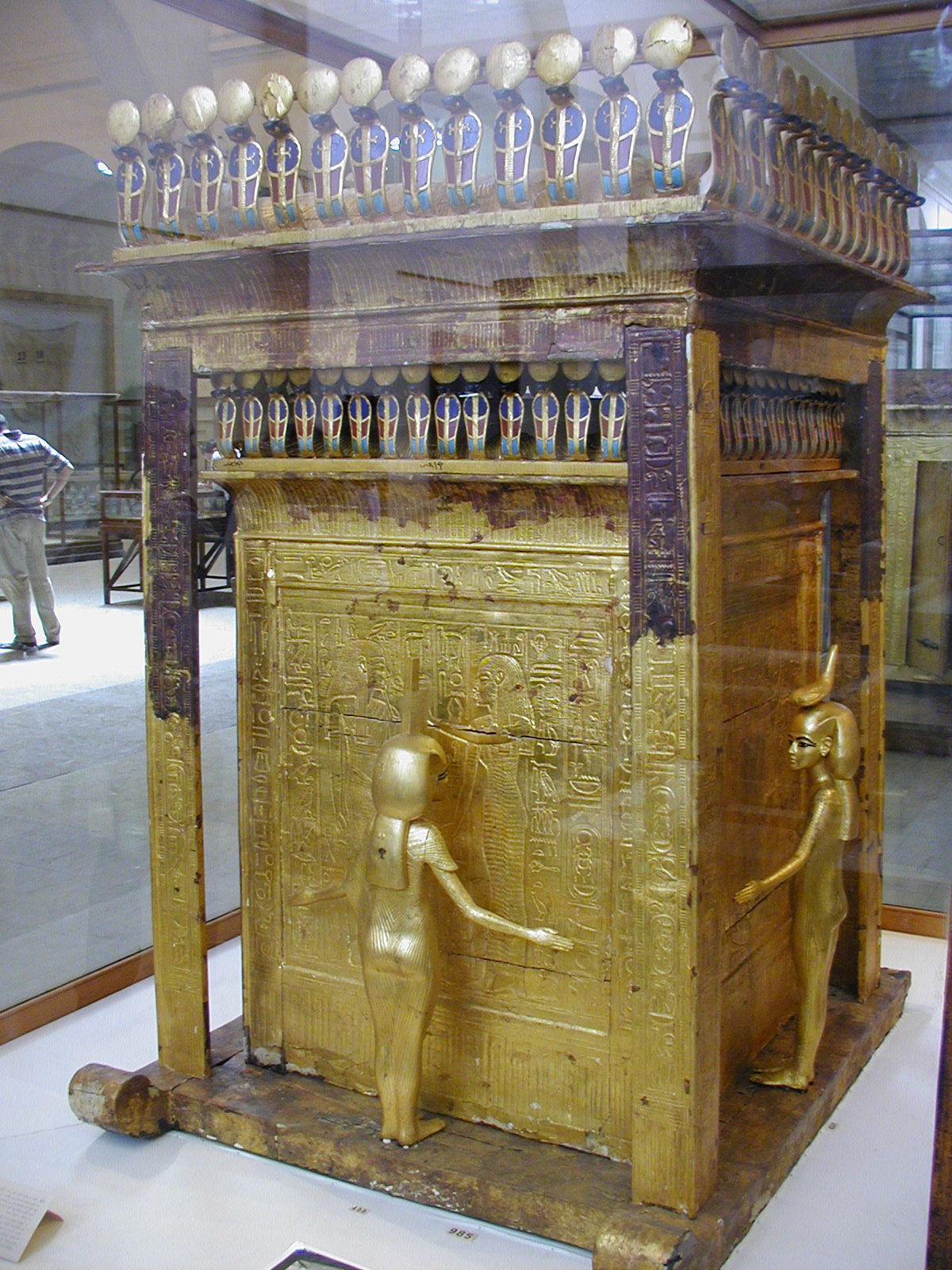
I thought I would inaugurate the series with one of my very favorite pieces from the tomb of Tutankhamun. The goddess statues from the canopic shrine - Isis, Selket, Neith, and Nephthys. The goddesses stand with their bodies toward the shrine, arms outstretched, faces to the side in a protective pose on the edges of the shrine containing Tutankhamun's preserved internal organs. The symbols on their heads indicate their identities. They wear very fine pleated linen gowns typical of the late 18th Dynasty. It is their faces in particular that I adore - the sweet, serene expressions are absolutely captivating to me.

Here is an image of the shrine itself in the Cairo Museum. Isis and Selket are visible:


And here is a closer view of Selket:
Personally, I think the finest photos of the Tutankhamun objects were probably taken by Harry Burton, the original expedition photographer "loaned" to Howard Carter by the Metropolitan Museum, New York. There is (or was) a traveling special exhibit of Burton's photos and there is also a lovely book featuring them.

Photo credits:
Photo of the outer canopic shrine by Gérard Ducher located at Wikimedia Commons
Photo of Selket by Snofru located at Wikimedia Commons