10.28.2010
Pinchy on the Road
Labels:
amigurumi,
archaeology,
awesome,
friends,
fun,
my projects,
photos,
silly,
travel
Truce?
| Apparently this is a "smooth Oreo" |
I've stayed in bed with my new pink jammies from my Nana and shared powdered donuts with Oreo and goofed off on the internets.
The monster has stayed away today. Hopefully will remain away.
10.27.2010
Don't Feed the Monster
| If I turn green and line-y, someone get me some better drugs, stat. |
Part of the trip was just to visit family I haven't seen in years. Another part of it was to see my Nana, who has esophageal cancer. She has chosen, with the approval of her doctors, to forgo treatment and so it is just a matter of time before she'll leave us. It was wonderful to see her. Her hearing and eyesight are not so wonderful and she tires more easily, but otherwise I think she's doing fairly well, all things considered.
Unfortunately, we didn't take the opportunity for a side trip to visit one of my uncles. He was admitted to the hospital the day after we went back to Las Vegas from Reno. He's in his 80s, his heart is apparently working at only 30% capacity. I haven't seen him or my aunt since I was married 7 years ago. My aunt has lost her hearing in the past few years, so communication is a bit challenging.
I had to watch my dad try to make the agonizing decision of whether to try to drive up there (and dad is disabled from arthritis in knees, hip, and back) to see his only remaining brother and possibly only contribute to the fuss and stress or wait and possibly not have a chance to say goodbye. Fortunately, my uncle seems to be doing a bit better and dad managed to talk to him briefly on the phone - he's mostly just tired and wants to rest.
Last night, from the time we got off the plane in Chicago and all the way home I was fighting back tears. I'm not entirely sure why - there are the obvious reasons, of course, but I don't usually do that sort of thing. I sobbed for quite a while when we finally got home. I've been doing the same thing on and off all day today.
I hate it.
I'm terrified it's the depression monster making a return. I've had only a few brief episodes of non-situational depression in the past 2 years - they were fairly minor and passed quickly.
This is awful. I can't point to a reason why I'm crying, I can't really point to a cluster of reasons. It was hard to come back to Chicago and the rigamarole of PT and therapy and doctors and work and bad weather and being shut in.
But mostly I'm just unspeakably, inexplicably sad and fragile and convinced everyone is upset or angry at me or about me and flitting about the edges, taunting me is that faint thread of "it would be easier if I were gone." It's not constant, it's not a plan, it is not yet to the emergency stage (and I give you all my word that we can judge when it does become an emergency and what to do and steps will be taken), but it is awful. It's not *me,* dammit.
I sway back and forth between wanting to talk and be with people and wanting the world to go away. I don't want for people to see me like this. And it's nearly impossible for me to really communicate sometimes when the monster is here. And I get so over-sensitive that it sometimes feels like everything anyone says is hurtful or angry or exasperated.
And then I have a few minutes of normal.
And then I'm overwhelmed again and even deciding to get up and have water is an agonizing decision.
And what else to do is a difficult or impossible to decide - what do I do to starve the monster instead of feeding it?
If I go and rest and try to sleep and cancel PT tomorrow to give myself another day to simply *be* at home is that good or is it chunking a juicy steak right at that bastard?
Should I keep aimlessly surfing the web or pick up a book or watch TV? And if I can't keep focused on any of those will it feed the monster more?
Should I force myself to do things or take a bit of rest? Is resting feeding the damn thing? Can I trust my natural inclinations or fight against them?
Am I just overwhelmed from travel and grief and pushing harder than usual and trying to hide symptoms and residual thyroid ick? Or is the monster coming to stay for a while?
| Wut? Does that mean that anxiety makes me sneeze? |
I'm hoping I'll feel better soon. I'd rather not make this blog into Emo Central.
10.17.2010
Safely Arrived
Yesterday was a long day, but the trip went smoothly, so that was awesome. The American Airlines people were very nice - the staff in Dallas even changed our seats for us to give me more legroom and less distance to walk. And got me a wheelchair for the jetway because it was a really long-ass jet-way.
Oreo was a good boy, as usual.
Tasty fried chicken from the comfort of my wheelchair
Oreo was a good boy, as usual.
![]() |
| Peeking out of the carrier |
Doing some crochet waiting for our connection in Dallas.
![]() |
| If you look closely you can see both the silver in my hair AND the stupid cystic pimples on my jawline. |
Our flightpath into Vegas brought us right over Hoover Dam, which was beautiful light up in the dark. I could just make out the silhouette of the new bridge against the lights shining up the face of the damn.
We slept in as best we could today, though Mom and Dad's younger schnauzer, Lily, is a punk and keeps starting stuff with Oreo. And Oreo gives it right back. Meanwhile, the older schnauzer (who is actually the same age as Oreo) Oliver just sort of patiently watches them be stupid and is a model sweetheart.
We got to see my brother and his wife and my nephew today for dinner. I'm tired and feeling a bit stiff and my joints are aching, but hopefully that will ease up soon.
It's overcast and smells of rain outside tonight - beautiful. I miss the desert.
![]() |
| View from the backyard |
10.15.2010
Blog-cation
Anyway, I'm not sure what or when or if I'll blog while I'm actually gone, but hopefully I will have hilarity and photos to share when we get back home if not before. At the moment, I've got my bed covered in clothes I am likely to pack, along with 2 books and at some point I plan to gather up some crochet hooks and yarn and some patterns to take to keep me occupied.
I'd rather not push my luck at security with pointed sticks, especially since we'll be having enough fun with Oreo (who has to be taken out of his carrier and have his harness taken off so he doesn't set of the metal detector), me with my CPAP, and me in and out of a wheelchair to get through security.
(The Double-Stuff Oreo mascot showed up via Zemanta as a possible image to include and it was too horrifying not to share.)
Man In Camo Suit Accused Of Museum Burglary - Portland News Story - KPTV Portland
Most hilarious part - he was spotted after he cried out in pain after one of the K-9 patrol dogs bit him.
I wonder if he was going to pretend to be random shrubbery *in* the museum if he got caught inside in his ghillie suit?
10.10.2010
Hashimoto keeps getting me down
Looks like the Plaquenil has done okay in bringing down some inflammatory markers, but apparently my thyroid is being a bitch again. Or my immune system is being a bitch to my thyroid. Yay, Hashimoto's thyroiditis
So, my TSH is high and my thyroid peroxidase is also high which means we probably need to up my dose of replacement thyroid hormone so my body will quit being all "ahhh! give me hormones!" and my immune system will quit being all "omnomnom tasty thyroid hormone."
I went in for more labs Friday and should get results this week along with some idea of how much we need to up my Synthroid.
I have to wonder how long this has been going on. I have been more tired the past few weeks/month and this week has been awful - I had to call in to work last night because there was just no way I had the energy to go. My job involves sitting there and occasionally interacting with people. I was too freakin' tired to do that!
Well and I had a migraine. But most of yesterday involved sleeping, waking up a bit and trying to read, falling back asleep, getting up for food or medicine and winding up winded just from the effort of moving. Not cool.
Anyway, I'm wondering if stuff I attributed to allergies, migraines, and the weather were in part signs that I was getting hypothyroid again. We'll see if daily sore throat, multiple migraines a week, random rashes, and extra exhaustion and brain fog go away with more Synthroid so maybe the next time this happens I'll be more likely to notice it.
I managed to get up the energy to shower today and I've been crocheting and watching movies. I'm supposed to work tomorrow night and by Flying Spaghetti Monster I will make that freakin' shift!
10.07.2010
Space photos of the day: Vintage NASA art - The Christian Science Monitor - CSMonitor.com
The slide show is awesome. I have to confess to having a little internal giggle every time I see the Dyna-Soar project mentioned.
I really want an inflatable space station.
And whoever drew the Apollo space suit (final slide) was clearly just phoning it in that day. "So, we'll get some toilet paper and duct tape..."
10.06.2010
Single Dad Laughing: The disease called "Perfection"
Single Dad Laughing: The disease called "Perfection": "- Sent using Google Toolbar"
Very much worth a read, as is the follow-up at the bottom.
Trying to be perfect, knowing I was perceived by some people as perfect, not wanting or being able to admit that I was not and didn't want to be perfect has been a major part of pressure and pain in my life. Learning to stop trying to be perfect or to expect other people to be perfect is the most useful thing I've ever done. It's a ongoing lesson and a hard one. But it's essential.
Very much worth a read, as is the follow-up at the bottom.
Trying to be perfect, knowing I was perceived by some people as perfect, not wanting or being able to admit that I was not and didn't want to be perfect has been a major part of pressure and pain in my life. Learning to stop trying to be perfect or to expect other people to be perfect is the most useful thing I've ever done. It's a ongoing lesson and a hard one. But it's essential.
10.05.2010
NY lawyer convicted in Dead Sea Scrolls case
| One of the dank holes from which scholarship comes |
Some of you may be familiar with the case of Raphael Golb, son of Dead Sea scholar Norman Golb. Raphael posted on various internet sites under assumed names, including under the name of one of his father's fellow scholars at NYU with whom he'd engaged in extended debate regarding the origin and authorship of the Dead Sea Scrolls.
There are more details available in the article and elsewhere on the web.
Frankly, the more I read about this, the more I think everyone involved is a douchebag. I'm not sure Raphael Golb committed a crime worthy of imprisonment, though essentially sock-puppeteering on behalf of his dad's pet theories while also criticizing the traveling Dead Sea Scrolls exhibit was a dick move as was posing as another scholar.
On the other hand, it seems like there are some people who gleefully looked for an opportunity to get Golb in trouble.
The politics surrounding the scrolls, their study, and interpretation is full of crazy on a multitude of levels.
Norm Golb has maintained that his son couldn't possibly have done it, that he (Norm) had nothing to do with it if he did, and has posited the existence of a conspiracy to make him look bad. Or something.
The politics surrounding the scrolls, their study, and interpretation is full of crazy on a multitude of levels.
Norm Golb has maintained that his son couldn't possibly have done it, that he (Norm) had nothing to do with it if he did, and has posited the existence of a conspiracy to make him look bad. Or something.
So, yeah. Academia. It's awesome. I'm frankly amazed this became public, this sort of thing is usually swept under several rugs and left to fester.
And all of distracts from actual scholarship and makes it all the more difficult to evaluate various theories when you have all this nonsense going on in the background and scholars with clear theoretical axes to grind who may well have gone beyond rational and are now clinging desperately to their ideas less out of actual conviction than bloody-minded stubbornness and a desire to avoid ever having to say their arch-rival might be right.
It does raise interesting questions about the use of pseudonyms on the internet. If I have multiple user names at various sites, am I committing fraud? How about if I register as a celebrity and post "as" them - is that a crime or is it permissible as fair use or satire or similar?
9.29.2010
Exercise medicine: Workouts prescribed to treat disease - chicagotribune.com
I have to say, I do feel better when I get in my morning exercise even though it's only about 15 minutes. It can be hard to push yourself to do it when you feel craptastic otherwise, but it's usually worth it.
The key, I think, especially for people who don't exercise regularly is to start very slow. I started out with just 5 minutes a day every day and have slowly built up from there. At the moment 15 minutes seems to be my max before I tire myself out for the day, but morning yoga and stretching with the Wii Fit loosens me up, helps with some of the stiffness and joint pain, and wakes my brain up.
9.26.2010
Time flies and junk
As expected, the NAMI walk did wear me out quite a bit. I spent most of Monday curled up in bed with Oreo and a book and even had a midday nap.
Tuesday was physical therapy which was harder than usual for me (still tired). And the trigger point injections were wearing off by then. My therapist was trying to do some range of motion and traction stuff with my neck and I just could not relax. The constant tension is a big issue for me in terms of posture and pain and migraine.
I forgot to mention last week that I had a chance to try out a recumbent tricycle last Saturday. It was absolutely amazing. I had a regular bicycle several years ago with the idea of using it to commute to campus. I didn't want to admit it at the time, but I was afraid every time I rode it. I didn't feel balanced or secure and I really wasn't comfortable turning and moving to look behind me. So I quit riding for some time. I thought maybe it was more the bike than me, so in 2008 Tom got a beautiful vintage Schwinn from a friend and we put rearview mirrors and wire panniers on it. I rode it twice, terrified both times that I was falling/going to fall. By the end of the second ride I was also in pain and exhausted. We eventually sold it. I occasionally look back on it with wistful regret - I love the sensation of riding, I was really hoping to get into touring (Dervla Murphy is a hero of mine) and riding used to be fun.
When I started physical therapy again, my therapist started having me warm up using their recumbent exercise bike. And it dawned on me that a recumbent bike or even better a trike might be something I could try to start riding again.
There was a sports fair nearby last weekend and a local bike store that sells adaptive bicycles had several bikes out. I tried an upright trike and it was okay, but not wonderful. I did feel much, much safer and more confident though. Then I tried the recumbent. It was amazing! Pedaling felt super efficient and wonderful and stretchy. My arms and hands were in a neutral position so there was no pain or tingling or numbness. I felt absolutely secure and far more confident of my ability to steer and be aware of things around me because I wasn't devoting so much attention to not falling or being afraid of falling. It felt a little like being in a go-cart. The only major problem was how low to the ground it was - which made it a challenge for me to get in and out of and made it a bit less visible. Nevertheless, I really fell in love with it. And there are models that are elevated a bit more to roughly the same eye level as a passenger car.
Unfortunately, they're fairly expensive, especially on our budget. But we're hoping to save up and maybe find something used or eventually squirrel away enough money. We're also hoping to go out to the bike shop one day to see if we can arrange a longer trail-ride for me to get a better idea of how I like it for longer than the 1/4 block or so I could ride at the sports fair.
I'm also planning on getting a pedal exerciser to work with while I'm on the couch or floor to build up some stamina in my legs and get some good stretching in.
In other news, the ArtFire opt-in drive got enough subscribers, including me, which means I will have an ArtFire Pro account for $5.95/month. I opt-ed in as a sort of "if it works, then I'll really buckle down and open shop." And it did. So, come November I hope to have at least a little something up and running. October is going to be entirely too busy for me to do it then - we're going to see my parents and my grandmother.
And, in less happy news, my Nana has esophageal cancer. She fortunately is not in any pain, but she is still having trouble eating despite having a stent put in to help expand the esophagus. Given her age and relative health she and her doctors have decided to forgo treatment and let nature take its course. I support her fully in this decision, and totally understand her desire to be as comfortable as possible in the time remaining rather than go through chemo or radiation and the side-effects related to them. It does mean, though, that it is just a matter of time until we say goodbye. I am, though, very grateful to have a bit of warning and the chance to prepare and say goodbye. I've been trying to talk to her at least once a week and she sounds fairly good. And, like I said, Tom and I are going to visit her mid-way through our trip out to see my parents.
9.19.2010
NAMIWalks Chicago 2010

![]() |
| On the lakefront |
Oreo can't quite make a full 3 mile walk (the block is sometimes a challenge) so he had to sit this one out. Instead, our friends brought their dog, Yuki. She's sweet and fluffy and beautiful and had lots of admirers. So I had good people and doggie friends to keep me company and help me out on the walk.
Our team raised $500 (thanks to all our donors!!!!)
9.17.2010
Just What Is Progress, Anyway?
Now let me try to explain why that's a bit of an epiphany for me.
For so long, I was trying so hard to convince doctors and myself and other people that something was wrong that hearing "that's better" or "well, that doesn't seem to be happening now" or "that's not too bad" was infuriating. Intended or not those reactions were often tinged with more than a hint of "and you're wasting my time" or "there's nothing wrong." And so I've been resistant to "you're looking better" because I had started just automatically assuming the stubborn mindset of "no, jackass, there is something wrong and just because I happen to be having a good day today does not mean that every day is like this one.
I've also started to realize that while some of my problems are interrelated or come as a set, others don't. I think it's taken me a little by surprise that my walking has improved because other things haven't. I don't have a lot more energy or strength or stamina. I still need my cane. But I can walk fairly well without the cane without weaving all over or tripping over my own feet or starting/stopping or having my lower back and pelvis moving all over the place.
And I do feel better between my daily Wii Fit and weekly PT. Not "cured" not "100%" but better. Baby steps. And so I still balance between frustration and acceptance on a daily basis. The fatigue and weakness and general ick are things that I'm increasingly thinking I'll just have to live with. I need to not lose sight of the progress I make on the things I can actually make progress on like walking and basic fitness and (hopefully) migraines.
Today's appointment also wound up with me getting novacaine injections into some trigger points in my neck and shoulders in the hope that will help my migraines.
According to my PT, because my shoulders are usually rounded and I carry my head too far forward, I'm overstraining the muscles in my neck and shoulders, which is not helping me in general, but can definitely be contributing to my migraines. So, we're going to continue working on that. Suggestions are welcome - I would be thrilled to get rid of the permanent aching knots in my neck and shoulders, especially the ones that make it feel like my shoulder is going to wind up in my ear during the worst of my migraines.
We're also upping the does of my preventative med to see if we can get it to work. I'll be very happy if I can quit with the 4 or 5 migraines a week. They're bad enough when they suck up two or three days a month but most of a week is just too much.
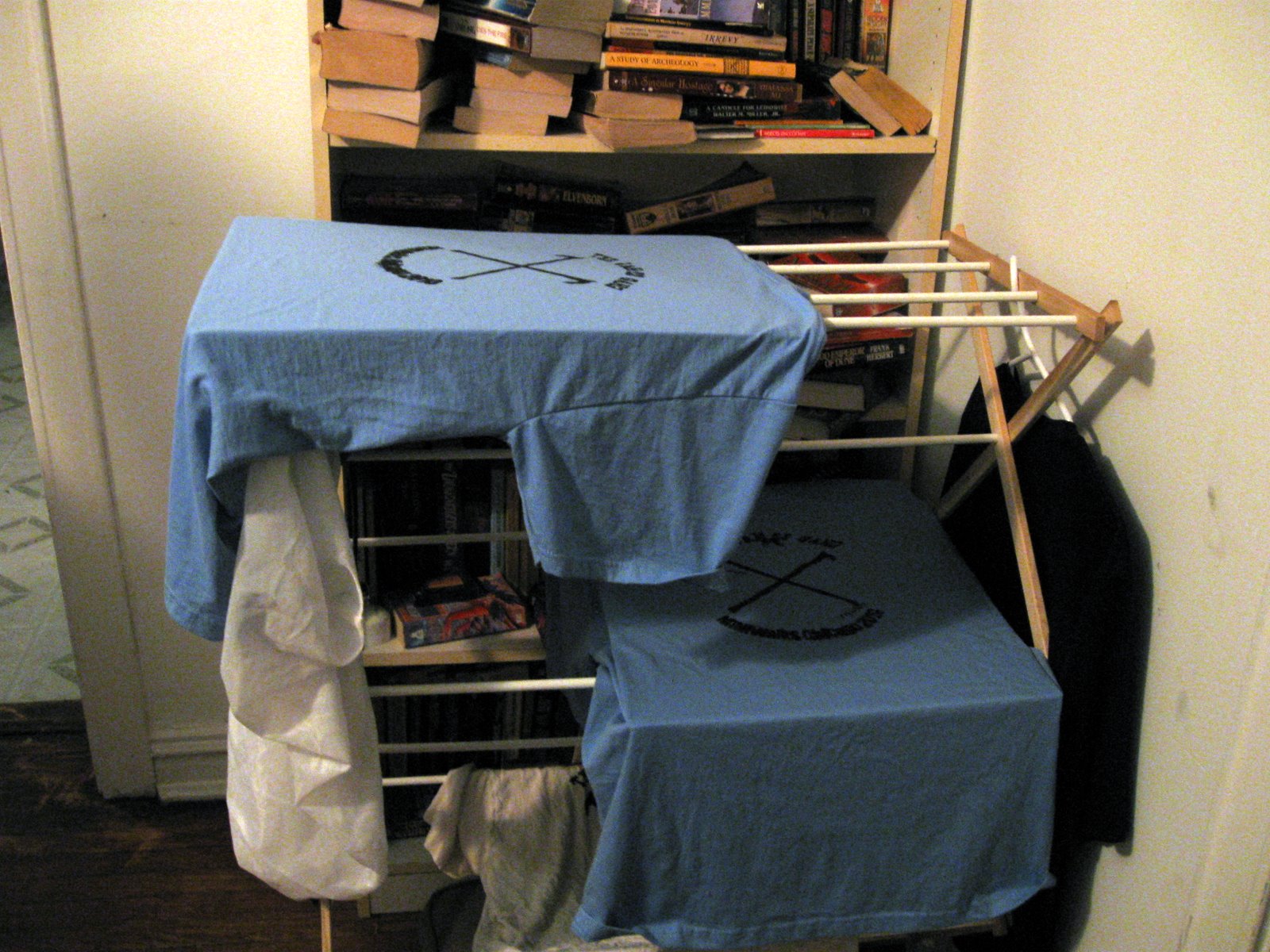
NAMIWalks Chicago - Team T-Shirts
NAMI has encouraged teams to get t-shirts. Tom and I decided we'd screenprint our own.
So, Tom found this tutorial on Instructables and I found a related one on Cut Out and Keep.
I wanted an Old West sort of font for the team name, since we're the James Gang and crossed canes.
Tom was nice enough to turn a photo of an ergonomic cane like the one I prefer to use into a silhouette in Illustrator. I did the rest in Inkscape (there was a lot of swearing while I was figuring out how to get text to arch).
I spent most of yesterday painting out the negative space in my screen - a quilting hoop holding some old sheer curtains. I mixed a bit of white acrylic paint with Mod Podge to paint out the negative space (the paint was so it was easier to see where I'd painted).
Tonight we pulled prints using fabric paint rather than proper screenprinting ink because netiher of us felt like going across the city to get proper screenprinting ink.
Pretty cool, huh?
Pretty cool, huh?
9.15.2010
ArtFire Group Deal - $5.95 Per Month - Limited Time Offer
ArtFire, for those who don't know, is one of the major competitors of Etsy. Like Etsy, they provide an online marketplace for handmade and/or vintage goods. Unlike Etsy, rather than have a per item surcharge for each listing, you can either have a limited account which allows you to post and sell a limited number items for sale for free or you can have an account that you pay for per month with an unlimited number of sales. ArtFire does not take a percentage of sales either - the flat-rate monthly fee is it. (Don't forget, though, that services like PayPal may charge fees for transactions).
ArtFire offers importing of Etsy listings so you can switch over entirely or maintain shops on both sites.
From the look of it, ArtFire may have some better, low-cost options for advertising and other marketing tools.
As I slowly consider opening shop I've looked at ArtFire and Etsy and have yet to decide which service to go with or whether to use both. Etsy has a huge following already, but ArtFire seems more flexible and depending on sales, etc., less expensive to manage.
In the interests of full disclosure, ArtFire is currently running a contest offering a table-top photo studio setup to anyone who blogs about the limited $5.95/month offer, so that is part of why I've written this post. But I also wanted to get the word out to my fellow crafters who already are selling online or who are contemplating doing so.
9.14.2010
30 Things About My Invisible Illness You May Not Know
1. The illness(es) I live with are: Chronic Fatigue Syndrome, Undifferentiated Connective Tissue Disease, Functional Movement Disorder, Sleep Apnea, Delayed Sleep Phase Disorder, Migraine, Mitral Valve Prolapse, Depression, Hashimoto's Thyroiditis
2. I was diagnosed with it in the year: Heh - a lot of the diagnoses came in 2008/9; some like the MVP well before that
3. But I had symptoms since: my mid-to-late teens, so about 15 years
4. The biggest adjustment I’ve had to make is: No longer being able to bounce back from illness or overwork or push past exhaustion or pain
5. Most people assume: That I'm "just tired," or that I only became ill very recently and don't realize I was coping with symptoms increasing in number and frequency over a long period of time.
6. The hardest part about mornings are: Getting going and trying to figure out how much energy I'll have for the day and how best to use it.
7. My favorite medical TV show is: MASH
8. A gadget I couldn’t live without is: My cane. Seriously, my cane means freedom and independence for me even on the days when my depth perception is shot and I have vertigo or my legs don't seem to want to function properly.
9. The hardest part about nights are: Getting to sleep, especially when I'm in too much pain to ignore it.
10. Each day I take __ pills daily (No comments, please) 9, assuming I don't take any "as needed" meds for pain or allergies, like Aleve, ibuprofen, Klonopin, Benadryl, etc. It's usually more than 9.
11. Regarding alternative treatments I: I do careful research and look for clinical studies and other information about certain treatments, in particular herbs and supplements, make sure there isn't a risk of interaction with any existing meds or illness, check with the appropriate doctor, and give it a try. My basic philosophy is that if it isn't hurting you in some way or interfering with evidence-based medical treatment and it makes you feel better, that's all to the good.
12. If I had to choose between an invisible illness or visible I would choose: I don't think I can make that choice.
13. Regarding working and career: I chose to give up my career as an Egyptologist because I simply couldn't manage finishing my PhD and then go on to try for a faculty position or do field work in my current condition and because I didn't think I could find an adequate balance of stress and health. But I have found ways to keep busy. I'm working part-time in a relatively low-stress position. I'm also slowly working on developing a home-based craft business. My entire perspective has shifted from living to work to working to live (cliched though that may sound).
14. People would be surprised to know: I think it depends on the person and how they think they know me. Some people would be surprised to know that I've accepted the reality of my illness and am, for the most part happy in spite of it all. Other people would be surprised to know that there are days when I sob over not being able to lift a milk jug because it reminds me of all I can't or find hard to do. Anyone who really knows me though, probably wouldn't be surprised at all to know that after the sobbing, I pull myself together and figure out a way to get the milk I wanted and then laugh at myself for getting all emo.
I doubt many people know or guessed that there were days when I felt so alone, so agonized, so guilty, so much a burden, and so hopeless that I wanted to die, because that would somehow be easier for me and everyone around me.
I don't know how many people know that when we were waiting for my Huntington's Disease test to come back (it was negative) my first thought was how horrible it would be for my husband to watch me decline and die and my second thought was wondering, if the test came back positive, what that would mean for my parents, half-brothers, and nephews and niece.
I don't know if anyone knows that there are days when I feel like a lazy, melodramatic, wimpy fraud.
15. The hardest thing to accept about my new reality has been: I have limits and I cannot predict how I'll feel from day to day. That some people just will not believe me or come even close to understanding what my life is like now.
16. Something I never thought I could do with my illness that I did was: Go out by myself further than just to doctor's appointments
17. The commercials about my illness: There are commercials? I don't have regular TV anymore - have they finally opened Cripples R Us?
18. Something I really miss doing since I was diagnosed is: Running, riding a bike, driving, digging
19. It was really hard to have to give up: Driving, but I don't feel safe and I can't bring myself to put other people at risk if my attention wanders or I have a weird muscle spasm or my depth perception is totally off.
20. A new hobby I have taken up since my diagnosis is: Crochet, Knitting, Sewing, Polymer Clay
21. If I could have one day of feeling normal again I would: Dance
22. My illness has taught me: Patience, the value of friendship, the value of family, ingenuity
23. Want to know a secret? One thing people say that gets under my skin is: I can't limit this to just one. "Oh, yeah, I'm tired too. We're all tired." And "You should get out more." And "It's all in your head." And "If you'd just try harder." And "But you're so young." And "But you don't look sick/in pain/tired." And "Have they figured out what's wrong (and fixed it) yet?"
24. But I love it when people: Ask if I need help, anticipate that I may not be able to handle certain things, genuinely try to understand what my life and illness are like now.
25. My favorite motto, scripture, quote that gets me through tough times is: You're never given a burden heavier than you can carry, no matter how much it may seem otherwise.
26. When someone is diagnosed I’d like to tell them: What you feel is real, your health is real, and your needs are real. Don't let anyone tell you otherwise. Learn to set limits and remember that because so many of your symptoms are invisible, you have to tell people how you feel. They aren't mind-readers. It will help you and the people around you adapt so much faster is they really know what's going on. Telling people "I'm in pain" or "I don't think I can do that" is not the same as complaining. It's being proactive.
Also, give serious consideration to exploring mental health counseling or therapy. The right therapist and program can help immensely with coming to terms with your health, coping with feelings of grief and guilt, and learning how to relate to the people around you. It doesn't mean you're "crazy" or that your illness is "all in your head" - it means that you're taking all the measures you can to keep yourself as healthy as possible and to learn as many coping skills as possible.
27. Something that has surprised me about living with an illness is: How quickly I've learned to cope.
28. The nicest thing someone did for me when I wasn’t feeling well was: Being there and supportive and undemanding
29. I’m involved with Invisible Illness Week because: I think it's important to add my voice and my experience to increase awareness of "invisible" illnesses - their existence and the experience of living them.
30. The fact that you read this list makes me feel: Grateful.
2. I was diagnosed with it in the year: Heh - a lot of the diagnoses came in 2008/9; some like the MVP well before that
3. But I had symptoms since: my mid-to-late teens, so about 15 years
4. The biggest adjustment I’ve had to make is: No longer being able to bounce back from illness or overwork or push past exhaustion or pain
5. Most people assume: That I'm "just tired," or that I only became ill very recently and don't realize I was coping with symptoms increasing in number and frequency over a long period of time.
6. The hardest part about mornings are: Getting going and trying to figure out how much energy I'll have for the day and how best to use it.
7. My favorite medical TV show is: MASH
8. A gadget I couldn’t live without is: My cane. Seriously, my cane means freedom and independence for me even on the days when my depth perception is shot and I have vertigo or my legs don't seem to want to function properly.
9. The hardest part about nights are: Getting to sleep, especially when I'm in too much pain to ignore it.
10. Each day I take __ pills daily (No comments, please) 9, assuming I don't take any "as needed" meds for pain or allergies, like Aleve, ibuprofen, Klonopin, Benadryl, etc. It's usually more than 9.
11. Regarding alternative treatments I: I do careful research and look for clinical studies and other information about certain treatments, in particular herbs and supplements, make sure there isn't a risk of interaction with any existing meds or illness, check with the appropriate doctor, and give it a try. My basic philosophy is that if it isn't hurting you in some way or interfering with evidence-based medical treatment and it makes you feel better, that's all to the good.
12. If I had to choose between an invisible illness or visible I would choose: I don't think I can make that choice.
13. Regarding working and career: I chose to give up my career as an Egyptologist because I simply couldn't manage finishing my PhD and then go on to try for a faculty position or do field work in my current condition and because I didn't think I could find an adequate balance of stress and health. But I have found ways to keep busy. I'm working part-time in a relatively low-stress position. I'm also slowly working on developing a home-based craft business. My entire perspective has shifted from living to work to working to live (cliched though that may sound).
14. People would be surprised to know: I think it depends on the person and how they think they know me. Some people would be surprised to know that I've accepted the reality of my illness and am, for the most part happy in spite of it all. Other people would be surprised to know that there are days when I sob over not being able to lift a milk jug because it reminds me of all I can't or find hard to do. Anyone who really knows me though, probably wouldn't be surprised at all to know that after the sobbing, I pull myself together and figure out a way to get the milk I wanted and then laugh at myself for getting all emo.
I doubt many people know or guessed that there were days when I felt so alone, so agonized, so guilty, so much a burden, and so hopeless that I wanted to die, because that would somehow be easier for me and everyone around me.
I don't know how many people know that when we were waiting for my Huntington's Disease test to come back (it was negative) my first thought was how horrible it would be for my husband to watch me decline and die and my second thought was wondering, if the test came back positive, what that would mean for my parents, half-brothers, and nephews and niece.
I don't know if anyone knows that there are days when I feel like a lazy, melodramatic, wimpy fraud.
15. The hardest thing to accept about my new reality has been: I have limits and I cannot predict how I'll feel from day to day. That some people just will not believe me or come even close to understanding what my life is like now.
16. Something I never thought I could do with my illness that I did was: Go out by myself further than just to doctor's appointments
17. The commercials about my illness: There are commercials? I don't have regular TV anymore - have they finally opened Cripples R Us?
18. Something I really miss doing since I was diagnosed is: Running, riding a bike, driving, digging
19. It was really hard to have to give up: Driving, but I don't feel safe and I can't bring myself to put other people at risk if my attention wanders or I have a weird muscle spasm or my depth perception is totally off.
20. A new hobby I have taken up since my diagnosis is: Crochet, Knitting, Sewing, Polymer Clay
21. If I could have one day of feeling normal again I would: Dance
22. My illness has taught me: Patience, the value of friendship, the value of family, ingenuity
23. Want to know a secret? One thing people say that gets under my skin is: I can't limit this to just one. "Oh, yeah, I'm tired too. We're all tired." And "You should get out more." And "It's all in your head." And "If you'd just try harder." And "But you're so young." And "But you don't look sick/in pain/tired." And "Have they figured out what's wrong (and fixed it) yet?"
24. But I love it when people: Ask if I need help, anticipate that I may not be able to handle certain things, genuinely try to understand what my life and illness are like now.
25. My favorite motto, scripture, quote that gets me through tough times is: You're never given a burden heavier than you can carry, no matter how much it may seem otherwise.
26. When someone is diagnosed I’d like to tell them: What you feel is real, your health is real, and your needs are real. Don't let anyone tell you otherwise. Learn to set limits and remember that because so many of your symptoms are invisible, you have to tell people how you feel. They aren't mind-readers. It will help you and the people around you adapt so much faster is they really know what's going on. Telling people "I'm in pain" or "I don't think I can do that" is not the same as complaining. It's being proactive.
Also, give serious consideration to exploring mental health counseling or therapy. The right therapist and program can help immensely with coming to terms with your health, coping with feelings of grief and guilt, and learning how to relate to the people around you. It doesn't mean you're "crazy" or that your illness is "all in your head" - it means that you're taking all the measures you can to keep yourself as healthy as possible and to learn as many coping skills as possible.
27. Something that has surprised me about living with an illness is: How quickly I've learned to cope.
28. The nicest thing someone did for me when I wasn’t feeling well was: Being there and supportive and undemanding
29. I’m involved with Invisible Illness Week because: I think it's important to add my voice and my experience to increase awareness of "invisible" illnesses - their existence and the experience of living them.
30. The fact that you read this list makes me feel: Grateful.
9.13.2010
Reality, "Negativity," and Acceptance - A repost from 2009 in honor of Invisible Disability Awareness Week
This post originally appeared here in April of 2009. Over a year later, I find I have a lot of the same feelings and experiences and wanted to share this for Invisible Illness Awareness Week
Being or becoming disabled requires a lot of adjustments. Some of these are obvious – changes in lifestyle, in jobs, in relationships, in daily activities. It requires a pretty major mental adjustment, too, one that often isn't obvious, or at least wasn't for me. My illness has been gradual in some ways – increasing fatigue and weakness over the span of years – and quite rapid in others – the onset of movement disorders, major increases in fatigue, etc. At first, I went into this with the idea that my doctors would figure out what the problem was, fix it, or at least figure out a way for me to compensate, and I would go on my merry way. Over the past year, it became pretty clear that that isn't going to happen. Realizing that not only is it extraordinarily unlikely that I'm going to wake up one day and be fine, but that my whole life now needed to change was, to put it mildly, intense. Accepting it was even harder.
Part of the issue is that I think we are taught to approach all sickness as something to be defeated or gotten over. This isn't necessarily a bad thing – there seems to evidence that mindset plays an enormous role in recovery from thing like cancer. A lot of us, and I definitely was (and to an extent, still am) one of these people, are also taught to “walk it off” or “push past it” and to hide or deny our symptoms. Again, this isn't necessarily a bad thing – fear of embarrassment, concern over keeping a job, avoiding making others uncomfortable, etc., are all good reasons to try to hide symptoms or deny that there is a problem. Unfortunately, it can also be very counterproductive.
I finally accepted that I am disabled, am likely to be so for the rest of my life, and that there is a chance my condition may decline a few months ago. I found it enormously liberating. Instead of feeling like my entire life was on hold until I was “well,” of being afraid to undertake new projects, of not knowing what I was going to do next, I could finally start looking ahead. I now plan based on how I feel now, not how I felt a year ago or 5 years ago, or how I wish I felt. That means that I have to set the bar quite a bit lower, but it also means that I have realistic goals and that I'm not constantly frustrated and depressed because I can't do x, y, or z. I've also come to see the silver-lining in getting sick – I've come to appreciate my family and friends, most especially my husband, even more, I'm under far less stress than I was as a graduate student, I'm less likely to feel guilty for spending time on things that I enjoy (I'm still working on this one), I'm more in touch with my creativity. In short, I'm much happier. I'd like to still be able to walk several miles without even breaking a sweat, or work full-out on a research paper for hours on end without getting utterly lost, but I realize that I can't and I've stopped feeling guilty and bad about it. Instead, I try for a few blocks a day and a few easy paragraphs on the blog. I won't go so far as to say the trade was worth it, but it could be much, much worse. The majority of my various doctors and specialists agree that my new mindset is much healthier and better for me and realistic.
The downside to this can be in relationships with other people. Most of my family and friends also agree that accepting my disability and working forward from it as good things and they've been wonderful about helping me cope. Unfortunately, there are a few people who don't see it that way. Like I discussed a little bit above, I think many people view illness or disability as something to be overcome and/or denied. So, for these people, I think that my acceptance looks like defeat or negativity. Some people have been very direct about saying this and I prefer that, because it's easier to have a discussion and explain how I think acceptance is very different from negativity or defeat. With other people, it can be much harder as it tends to be clear only from their actions or implied in their words that they feel it's negativity. I suspect being unfamiliar with the details of my situation probably contributes as well – on a good day I look like a relatively attractive, healthy young woman who happens to have a cane. Pain doesn't advertise, I've learned to compensate for or hide my tremors unless I'm having a particularly bad day, and my balance problems are also fairly hard for others to notice. My fairly direct manner may also contribute - if I'm having a bad day, I say so. If my hands are shaking badly, I say so. How is anyone going to know that I need help going down those stairs or opening that bottle if I don't say so? And I tend to crack jokes about it too. The "negativity reaction" is something that still bothers me, however, even though I know I probably shouldn't let it. I'm tempted at times to snap at people "I'm not freakin' negative, you jackass, I'm a realist, and that's different. Stagger a mile in my shoes!" Obviously that would be counterproductive. Instead I fume a bit and then go find something distracting.
I'm sure I'm not the only one with this problem, but I wanted to put it out there for others to see, those with and without disabilities. Obviously, not everyone approaches their health in the same way and what has worked for me may not work for other people, but I think keeping these things in mind can be helpful in basic, everyday interactions for everyone. I hope anyone with any thoughts will feel free to post here if they'd like.
Being or becoming disabled requires a lot of adjustments. Some of these are obvious – changes in lifestyle, in jobs, in relationships, in daily activities. It requires a pretty major mental adjustment, too, one that often isn't obvious, or at least wasn't for me. My illness has been gradual in some ways – increasing fatigue and weakness over the span of years – and quite rapid in others – the onset of movement disorders, major increases in fatigue, etc. At first, I went into this with the idea that my doctors would figure out what the problem was, fix it, or at least figure out a way for me to compensate, and I would go on my merry way. Over the past year, it became pretty clear that that isn't going to happen. Realizing that not only is it extraordinarily unlikely that I'm going to wake up one day and be fine, but that my whole life now needed to change was, to put it mildly, intense. Accepting it was even harder.
Part of the issue is that I think we are taught to approach all sickness as something to be defeated or gotten over. This isn't necessarily a bad thing – there seems to evidence that mindset plays an enormous role in recovery from thing like cancer. A lot of us, and I definitely was (and to an extent, still am) one of these people, are also taught to “walk it off” or “push past it” and to hide or deny our symptoms. Again, this isn't necessarily a bad thing – fear of embarrassment, concern over keeping a job, avoiding making others uncomfortable, etc., are all good reasons to try to hide symptoms or deny that there is a problem. Unfortunately, it can also be very counterproductive.
I finally accepted that I am disabled, am likely to be so for the rest of my life, and that there is a chance my condition may decline a few months ago. I found it enormously liberating. Instead of feeling like my entire life was on hold until I was “well,” of being afraid to undertake new projects, of not knowing what I was going to do next, I could finally start looking ahead. I now plan based on how I feel now, not how I felt a year ago or 5 years ago, or how I wish I felt. That means that I have to set the bar quite a bit lower, but it also means that I have realistic goals and that I'm not constantly frustrated and depressed because I can't do x, y, or z. I've also come to see the silver-lining in getting sick – I've come to appreciate my family and friends, most especially my husband, even more, I'm under far less stress than I was as a graduate student, I'm less likely to feel guilty for spending time on things that I enjoy (I'm still working on this one), I'm more in touch with my creativity. In short, I'm much happier. I'd like to still be able to walk several miles without even breaking a sweat, or work full-out on a research paper for hours on end without getting utterly lost, but I realize that I can't and I've stopped feeling guilty and bad about it. Instead, I try for a few blocks a day and a few easy paragraphs on the blog. I won't go so far as to say the trade was worth it, but it could be much, much worse. The majority of my various doctors and specialists agree that my new mindset is much healthier and better for me and realistic.
The downside to this can be in relationships with other people. Most of my family and friends also agree that accepting my disability and working forward from it as good things and they've been wonderful about helping me cope. Unfortunately, there are a few people who don't see it that way. Like I discussed a little bit above, I think many people view illness or disability as something to be overcome and/or denied. So, for these people, I think that my acceptance looks like defeat or negativity. Some people have been very direct about saying this and I prefer that, because it's easier to have a discussion and explain how I think acceptance is very different from negativity or defeat. With other people, it can be much harder as it tends to be clear only from their actions or implied in their words that they feel it's negativity. I suspect being unfamiliar with the details of my situation probably contributes as well – on a good day I look like a relatively attractive, healthy young woman who happens to have a cane. Pain doesn't advertise, I've learned to compensate for or hide my tremors unless I'm having a particularly bad day, and my balance problems are also fairly hard for others to notice. My fairly direct manner may also contribute - if I'm having a bad day, I say so. If my hands are shaking badly, I say so. How is anyone going to know that I need help going down those stairs or opening that bottle if I don't say so? And I tend to crack jokes about it too. The "negativity reaction" is something that still bothers me, however, even though I know I probably shouldn't let it. I'm tempted at times to snap at people "I'm not freakin' negative, you jackass, I'm a realist, and that's different. Stagger a mile in my shoes!" Obviously that would be counterproductive. Instead I fume a bit and then go find something distracting.
I'm sure I'm not the only one with this problem, but I wanted to put it out there for others to see, those with and without disabilities. Obviously, not everyone approaches their health in the same way and what has worked for me may not work for other people, but I think keeping these things in mind can be helpful in basic, everyday interactions for everyone. I hope anyone with any thoughts will feel free to post here if they'd like.
LOLOtzi
Photo from here. Yes, I am incredibly immature. You should all know this by now.
Buhhhhh
This has led to me slacking off on doing Wii and my PT exercises at home. Not good. Working on that.
I did, however, discover that if I really feel like I shouldn't do the Wii (as opposed to just being a bit lazy) I probably shouldn't do the Wii. I had a migraine Friday but though "oh, well, if I just do some of the standing yoga poses so I'm not moving too much or lowering my head (that makes stuff hurt worse) it'll be fine and maybe I won't feel so stiff and sore." I did the Warrior pose, the Palm Tree, and the Chair. Half-way through the Warrior pose I started to sweat and shake, with the Palm Tree is was practically vibrating and started getting nauseous, and the Chair I nearly fell over and actually soaked through my shirt with sweat in a few places. This was a 6 minute long workout. I usually do 15 minutes and don't break a sweat even if it's a bit warm. So, yeah.
My involuntary movements have made a come-back as well, usually on the same day as a migraine. Fun times. I've been really, really stiff lately too - mostly muscles rather than joints from right after I get out of bed. Yoga with the Wii helps a bit, so does a warm shower, but if I stay in the same spot too long, my back stiffens up.
My shoulders and neck are permanently tense again which is part of the migraine feedback loop. And my sciatica or whatever the hell it is that makes it feel like someone is pinching my ass from the inside or sending laser beams from my ass down to my heel is flaring up.
Anyway, I have a neuro appointment this coming Friday. We'll see what else we can do with the migraines, I plan to ask about a specialist. I've done some reading about vertiginous migraine which is sort of interesting and might help explain some of my balance problems. Or not. Whatever. I just want to stop having the damn things so often. I feel like crap when I have them and can't get much of anything done, then I have the hangover, which sometimes lasts a whole day or more and then it seems like by the time I've recovered from one, another one shows up. If I get too active too soon it can trigger another one (like last week when I had to hobble-run for a bus that didn't follow the proper route, missed it, and then had to haul ass for 2 blocks to make it to an appointment without being late; within an hour I had an aura coming on and within an hour of the aura the pain hit.)
I've also started having the occasional one on my left side. In the past they were always on the right and even now are usually on the right. So, maybe a specialist, maybe we'll up the dose of nortriptyline or try something else. I might also see if it's worthwhile to have another sleep study to see if my apnea has gotten worse and is maybe contributing.
The image is of cortical spreading depression, which is one of the models for explaining visual aura in migraines.
9.12.2010
Ancient Nubians Drank Antibiotic-Laced Beer : Discovery News
Very interesting, especially as they seem to have adequately accounted for possible modern contamination.
A lot of grain storage in the Neolithic (well before this) was in pits, sometimes inside large clay vessels in the pits, sometimes just in a pit. If this population was using a similar storage method, then the growth of Strep is fairly easily explained.
Pretty cool.
And another example of the vast amount of information you can get from burials if you know how to take advantage of them.
9.09.2010
Very Cool Ancient Writing Demonstrations Video
Facebook | Videos Posted by Oriental Institute- University of Chicago: Visible Language
As I've mentioned before, the next temporary exhibit at the Oriental Institute is "Visible Language" focusing on the development, spread, and use of writing in ancient Egypt and the Near East.
Even people who are not a part of Facebook should be able to view the video at the link above. If you can't, please let me know in the comments or via email and I will be sure to make other arrangements.
It's a great demonstration of how Egyptian hieroglyphs were written with reed pen and ink on papyrus and how cuneiform was impressed in soft substances like clay with a wedge-shaped stylus.
There isn't any commentary, but it's still a fabulous visual demonstration. The Egyptian is written by Ray Johnson, who is the director of the Epigraphic Survey in Egypt and the cuneiform is written by Theo van den Hout, who is a professor of Hittitology and currently the head of the department of Near Eastern Languages and Civilizations at the University of Chicago. They're both two of my favorite people around the OI (well, Ray is in Egypt 6 months of every year), so I'm especially happy to share the video.
9.08.2010
9.07.2010
NAMI Walks - 12 Days
I just wanted to remind all my readers that the Chicago charity walk for the National Alliance on Mental Illness is just 12 days away.
I will be participating in the 3 mile (!) walk with the help of my trusty cane and new, sparkly sneakers along with friends and family who have joined our walk team - the James Gang.
This is a big deal for me for several reasons:
I will be participating in the 3 mile (!) walk with the help of my trusty cane and new, sparkly sneakers along with friends and family who have joined our walk team - the James Gang.
This is a big deal for me for several reasons:
- I've learned first hand the stigma that can go along with mental illness, not just in the general public but even among health care providers and want to fight it to improve treatment and access to treatment for everyone. A huge part of that is helping people to realize that mental illness isn't a character flaw, isn't nothing to worry about, and can affect ANYONE at ANY TIME.
- This will be my very first charity walk.
- I care enough about this to walk 3 miles which for me with my various health issues is a fairly significant distance.
- I have awesome family and friends supporting me!
9.04.2010
Screaming Ba Bird
No, really, check it out. It's screaming. I blame the Romans.
Labels:
ancient egypt,
archaeology,
egyptology,
glass,
jewelry,
link,
romans,
silly
9.02.2010
9.01.2010
Really delayed gifts involving scorpions
Late one night in Sudan I was getting ready to go to bed. I headed off to the latrine with my trusty headlamp turned on, pulled the plastic tarp nailed to some boards that we euphemistically referred to as a "door" open and had my heart stop for a few seconds. Camped out right next to the toilet paper (on the ground) was a scorpion. A big one. Probably of the deathstalker variety. It was late and I had been and continued to be sick and weak, so I went in search of someone with sufficient upper body strength and testicular fortitude to kill the nasty thing with a shovel.
Eventually most of the team wound up hanging around the latrine to peek at the scorpion. Finally Tom wanders by along with another male member of the team - Scott. A debate ensues regarding whether we should kill the scorpion, chase it off, or catch it and release it somewhere else. Mostly, I really need to pee and I was almost asleep on my feet so I finally snarled something to the effect of "get it the hell out of there so I can pee, dammit."
Scott went off to fetch a tin can and somehow got the scorpion into it. I got Tom to stand guard outside the latrine while I used it as though that would somehow protect me from scorpions. Then I went to bed.
Meanwhile, Scott was showing off his new friend, "Pinchy."
Image by shovelingtom via Flickr
After a while, Scott took Pinchy off into the desert and let him go. The villagers were less than pleased by Pinchy's reprieve - scorpions are serious business. While a scorpion sting usually kills only the very young, old, or sick, the pain is supposed to be horrific and nearly maddening and often there isn't much that can be done but wait it out. Thus, they kill the little bastards on sight.
Anyway, several months later after we'd all come home and Tom and I wound up moving to a different apartment, Scott sent us a lovely housewarming gift and I decided he needed to have a memento to remind him of Pinchy and his 2 months in the Sudanese desert with a bunch of crazy people.
So, I crocheted a scorpion. I think I borrowed the claw pattern from a free lobster pattern and made up the rest as I went along. And found a can to put it in. And then let it sit on my desk for a year because procrastination is cool or something.
So, after staring at it and thinking "hrm, I should put together the package of stuff for Scott and mail it" for the thousandth time today, I decided to actually, you know, do it. Yay!
I made sure to document Pinchy too.
Eventually most of the team wound up hanging around the latrine to peek at the scorpion. Finally Tom wanders by along with another male member of the team - Scott. A debate ensues regarding whether we should kill the scorpion, chase it off, or catch it and release it somewhere else. Mostly, I really need to pee and I was almost asleep on my feet so I finally snarled something to the effect of "get it the hell out of there so I can pee, dammit."
Scott went off to fetch a tin can and somehow got the scorpion into it. I got Tom to stand guard outside the latrine while I used it as though that would somehow protect me from scorpions. Then I went to bed.
Meanwhile, Scott was showing off his new friend, "Pinchy."
After a while, Scott took Pinchy off into the desert and let him go. The villagers were less than pleased by Pinchy's reprieve - scorpions are serious business. While a scorpion sting usually kills only the very young, old, or sick, the pain is supposed to be horrific and nearly maddening and often there isn't much that can be done but wait it out. Thus, they kill the little bastards on sight.
Anyway, several months later after we'd all come home and Tom and I wound up moving to a different apartment, Scott sent us a lovely housewarming gift and I decided he needed to have a memento to remind him of Pinchy and his 2 months in the Sudanese desert with a bunch of crazy people.
So, I crocheted a scorpion. I think I borrowed the claw pattern from a free lobster pattern and made up the rest as I went along. And found a can to put it in. And then let it sit on my desk for a year because procrastination is cool or something.
So, after staring at it and thinking "hrm, I should put together the package of stuff for Scott and mail it" for the thousandth time today, I decided to actually, you know, do it. Yay!
I made sure to document Pinchy too.
| Re-enactment of discovering Pinchy in the latrine |
| Recreation of Pinchy's temporary home. |
| Pinchy, hanging out where he blends in like the sneaky little bastard he is. |
| Close-up. He can smell your fear. |
Labels:
amigurumi,
archaeology,
crochet,
friends,
funny,
gifts,
my projects,
silly,
snark,
Sudan
Subscribe to:
Posts (Atom)